Showing posts with label Maharishi School. Show all posts

Saturday, May 9, 2015

I've Enjoyed Being a Journalist

I suppose writing news for Maharishi School makes me more a press agent than a journalist since I'm writing press releases often for the media, but I still prefer journalist since I'm using the 5W + how for accuracy and detail. Besides, journalist is more Indiana Jones; press agent is more James Boswell.

I could also be called a professional blogger, even though I'm not living off my own business blog. Most of what I write is for Maharishi School's website blog, and when I shuffle pieces off to the media, I rewrite if necessary to a more conservative style and tone. (That's not usually necessary for sports, though! "Pioneers Crush Trojans!")

One result of this year's news writing for marketing is that I've worked with more everyday prose on the skill of writing for a particular effect. I write an article to motivate people to come to an event or to participate in a fund-raiser or to admire a student's achievement. Getting across the facts is essential, but also essential is having the words produce a subtle but real emotional response. Honing the prose to hone a reader's response has been a rewarding and illuminating experience.

An example of using detail to hone readers' response is the recent article "Spring Gala 'Iron Chef' Competition." Yes, I wanted to provide the basics of describing the contest and who won, but I also wanted to provide detail that revealed the expertise of the chef and, therefore, the success of Maharishi School's enrichment elective cooking program. I decided to accomplish this by using the winner's description of process and ingredients, allowing the specificity of detail to indicate competency. I think that worked.

Writing Maharishi School alumni profiles was also another experience in writing for an effect. In the profiles, my job was, in about 150 words, to project success, fulfillment, and expertise--that these alumni are in the "top of their game" in their fields. This, of course, wasn't a stretch since they are experts, innovators, and role models of how to succeed in making the world a better place. However, projecting this in 150 words or fewer was an excellent exercise in "less is more." It was fun to write the rough draft and then to begin leaning down the writing. What words could I eliminate and still say the same thing? How could I concentrate meaning? What events, awards, and activities really portrayed dynamic, successful interaction in a particular field?

Focusing on the connotative elements of language is not a new experience for me. Especially when writing poetry, but with all creative writing, the connotative flavors of a word are just as important as the denotative exactness. Working with this reality, though, in non-fiction news was a new experience, and I think I'm a better writer for that experience.

I always told my students that writing was a skill that improved with practice. And dang me if it ain't true!

Copyright 2015 by Thomas L. Kepler, all rights reserved

Sunday, September 28, 2014

Writing for Maharishi School--a New and Interesting Angle to Writing

I've been enjoying writing so much as a "journalist" that it's been a month since I posted here.

I promise to post here more often now. Here are some favorite posts to the Maharishi School blog that I've written in the last month. It was a pleasure to write these, and I'm happy to share them with you.

Laurie Kavanaugh Retires After 32 Years at Maharishi School
If service or volunteerism were to have a face, it would be that of Laurie Kavanaugh, a “just shy of 32 years” staff member at Maharishi School, who is retiring this September. During those years, she has worn many hats, but they all centered around helping the school run smoothly.
Maharishi School Senior Dia Huggins Volunteers in Africa 
Their service project was to build a library, “the first of its kind in the area,” next to the school in the community of Loibor Siret. The students would then teach “in the school, conduct animal counts on the Maasai Steppe, monitor game cameras, and participate in building ‘living walls’ to reduce the conflict between lions and the cattle of the Maasai herdsmen.”
Greg Thatcher, Teacher and Artist, Pursues His Vision in England
What does a fine artist who is also a teacher do for recreation when the school year ends? If you’re Maharishi School art teacher and department chair Greg Thatcher, you go to England and spend a month drawing the sacred yew trees in St. Mary's Churchyard, Painswick, Gloucestershire.
Maharishi School Senior Wins First Place in Entrepreneurial Course at Babson College
Maharishi School senior Zhou, Huijun (Queena) attended this summer a five-week Entrepreneurial Development Experience course at Babson College at its Wellesley campus in Babson Park, Massachusetts, outside of Boston. Her course-long team project, “Foundation Education,” designed a non-profit tutoring organization and won first place among the course’s 69 students that composed 19 groups.
I've found the discipline of writing this blog has made writing regular press releases and posting them on the school's Facebook pages not a big learning curve. One main (and good) lesson has been to write from a professional rather than personal perspective--more objectivity, I suppose. Another good learning point has been to regularly let others (my editors/bosses) preview my writing. That's leaned up my prose.

I could also talk about what I'm learning about marketing, but I think I'll save that for another post. Nice to be back, hope you're glad to hear from me.

Note: I'm re-posting this article since my blog was off the internet for about two weeks. I had originally posted it on my original blogspot site rather than my dotcom site, but I don't think it was forwarded as usual.

Copyright 2014 by Thomas L. Kepler, all rights reserved

Sunday, August 17, 2014

I Leave Retirement and Return to Maharishi School

Yes, I made the decision to return to a full-time job.

I won't be teaching though; rather, I'll be writing press releases and working with social media for Maharishi School. The work will be  something I've done before, yet not to the level of focus that I'll have in the Development Office at the school.

The question, of course, is why I decided to leave retirement for full-time work. After all, I was really enjoying retirement. Well, the answer is that I did it for my wife in order for it to be easier for her to leave her current position, to have more time for family, and to also help provide the opportunity for her to work for herself.

I decided that working at Maharishi School would be a lot easier on me than her current work load and environment is currently for her. It wasn't too difficult to make that decision, though. After one week of work, everybody at school has been very positive and supportive.

Years ago, before I decided to enter education, I really wanted to be a journalist. Now I have the opportunity to research, write, and publish articles daily. I had fun last week and also learned a lot.

The world has progressed too much over the years for me to enter the printing room and shout, "Stop the presses!" I might be able to shout into the copy room, though, "Pause the printer!" It doesn't quite have the same ring to it, but I'm comfortable with the decision I've made. I suppose I've just "paused" my retirement for a good cause. 'Nuf said.

Copyright 2014 by Thomas L. Kepler, all rights reserved

Monday, July 1, 2013

Free and Discounted Books During the Summer/Winter Promotion at Smashwords


For this July, my four books available at Smashwords will be free or discounted.

All you have to do is to go to the book's page, use the coupon, and download the e-Book. Smashwords formats the books for all platforms--e-readers, pads, and computers. Kindle (mobi) format is included.

Here is my Smashwords author page link, a handy portal to all my books. Download coupons are listed at the book sites (SW100 for 100% off and SSW75 for 75% off).

These books are available for free:
 These books are available for 75% off:
  •  The Stone Dragon  "Tom Kepler uses Glimmer's story to examine the nature of magic, of power, of consciousness, of the grand adventure of becoming." 
  • Love Ya Like a Sister (a young adult novel, called "gritty" by some, where values prevail)

That means that all my books distributed through Smashwords are available either for free or for $1.00.

The sale will last for the entire month of July. You will find many Smashwords authors participate in this summer promotion.

Enjoy! And please review my books. Reviews are the life-blood of an author because of the insights they provide readers.

Saturday, January 19, 2013

"I Write: Being & Writing" Featured in Transcendental Meditation Online Magazine

"Here, have a copy of my new book, I Write: Being and Writing," I told Dr. Richard Beall, the head of Maharishi School, where I teach.

This was several months ago when he was traveling out of the country, so I knew he'd have some air travel time. Dr. Beall is our hands-on advocate of Consciousness-Based education, and his hands are always filled with a million things to do. I shamelessly took advantage of the "opportunity" that he'd be flying across the Atlantic Ocean and dropped off a copy of the book the night before he left town.

The result of my bold little gift was that the book is the focus-point of Dr. Beall's recent article in Enlightenment: The Transcendental Meditation Magazine. Entitled "Waking the Inner Writer: Consciousness in the Classroom," the article focuses on Maharishi School's innovative approach to education, an approach that emphasizes not just course content but also the consciousness of the learner.

"Tom Kepler is an English-Language Arts teacher at Maharishi School in Fairfield, Iowa, who challenges us to look beyond the words to realize the significance of the writer within," Dr. Beall states at the beginning of his article.

That is indeed one of the key concepts of the book, that writing is an intimate and accurate reflection of the consciousness of the writer, and that as writers we must consider not only the word but also the source of the word. I think it no exaggeration to refer to the words of the Bible in John 1:1. "In the beginning was the Word, and the Word was with God, and the Word was God." Words are the manifestation of what lies within us, and if we can only clean that channel from which consciousness flows to thought and thought to word, then our writing will be not only more uniquely our own but also more completely cosmic.

“As writers, we have to consider the subject, the ‘I.’ If I am dull or impatient or distracted or unhealthy, what I write will lack my full potential. Like an athlete, I must be fully engaged, alert. I must continue to grow and expand as a person,” is one way I express this in I Write: Being and Writing.

The book is divided into three parts: the writer, the process of writing, and the written word. In each section, I address the relationship between the techniques of writing and the awareness that we bring to writing. Most often writing about writing only focuses on processes or how "how to get into print." I wanted to balance that emphasis with a consideration of writing as a reflection of who we are.

Even for the most mono-focused, obsessed writer, writing is, at the end of the day, just one aspect of our lives. Who we are is the big issue--and is the basis of what we write.

At Maharishi School, I am happy to say, there is a healthy balance of both providing knowledge and expanding the ability to know. In terms of writing, Dr. Beall describes this as the process "to construct a pipeline between the inner reservoir of creativity and intelligence, and the writing process." I send my thank-you's to Maharishi School, to Dr. Beall, and to the students, the parents of those students, and to the faculty and staff with whom I interact every day. I may be the teacher, but I learn something and grow as a person every day at Maharishi School.

As writers, all of us have a new paradigm to follow, not just to increase our "hand-eye" coordination to more quickly type out more words, but also to improve our  "mind-word" coordination in order to write with greater depth and power. We should all follow in the footsteps of Maharishi School's children and start each day of writing with the purity of a clean slate.

Copyright 2013 by Thomas L. Kepler, all rights reserved

Tuesday, October 2, 2012

I Write: Being & Writing--Published through CreateSpace/Amazon Rather Than Lightning Source

The experiment is complete--I Write: Being & Writing available through Amazon/Create Space rather than Lightning Source--and I am satisfied.

You might wonder at the word satisfied. Why not thrilled or ecstatic?

My experiment was to use CreateSpace's templates, to publish using a Word template for the interior block and the CreateSpace template software for the cover. Within the limitations imposed by using the templates, I am completely satisfied with my book--but there also is the inescapable truth that those limitations exist.

I wanted to use the simplest approach so that when I used the process with my students, putting together the book was as straightforward, easy, and quick as possible. I feel that the CreateSpace process fills that need. I published I Write: Being & Writing to become familiar with the software and whatever quirks existed in the process. That really took little time, having already published three books through Lightning Source.

You might imagine going to school at a large university and then transferring to a community college; the processes would be essentially the same to enroll and register for classes. It was like that for going from Lightning Source to CreateSpace. Instead of InDesign, I used Word. Instead of PhotoShop, I used CreateSpace's Cover Creator software. The results were predictable, and the limitations were what one would predict.
  • Some lines in the interior have more space than I would like, due to Word's lack of tracking sophistication that InDesign has.
  • I have to alter some of CreateSpace's Word template's styles to achieve a less intrusive look, such as centered, two-line titles (chapter number and title), rather than all caps left-hand titles that started with a chapter numeral.
  • Word software is always a mystery and is less predictable than InDesign, although InDesign is much more complex. It took a while to understand the logic of whomever set up the template. This is nobody's fault, but it did take time.
CreateSpace does explain in its instructions that the Word templates for the interior can be altered. The company also provides opportunities to choose from a variety of cover templates, and then those templates have some capacity for alteration, such as uploading your own cover image. The cover may end up with a flavor of boilerplate familiarity, but for my non-fiction book, the blocked visual layout was okay with me.

Online software at CreateSpace also allows one to see how the interior and cover will look. This is a great feature to provide continual assessment of the book as you go. If something is below standard, such as a photo lacking resolution, then the software informs you. Once you are ready to publish, the software automatically will generate the PDF for the interior and for the cover. This is a great feature. It should be mentioned here for those who are more advanced with publishing software that one can use more sophisticated software such as Adobe products, create the bookblock and cover, convert to PDF, and then submit those, just like at Lightning Source.

The big question is whether my next book will be a Print on Demand book through Lightning Source or through CreateSpace. This seems to be a hot topic on the internet. One good article (pro-CS) is "Why is Cool Gus Publishing switching from Lightning Source to CreateSpace?" I cannot argue with any of the ideas presented--lower price, helpful aids to evaluate the evolving cover and interior block, quite a lot of online advice, to mention a few.

However, at this time I like it that Lightning Source works with me as a publisher, Wise Moon Books, and not as an author who wants to independently publish. It's kind of like dealing with the Apple company. The services are great yet are also completely controlled by the vision of one company. As a publisher, do I want that?

I honestly can't answer that question at this time. My next book is a year off--revision and formatting still in the future. I've got a while to read, discuss, and consider. In the meantime, I Write: Being & Writing is available as a paper and eBook through CreateSpace/Amazon and Kindle. It should also soon be available through Smashwords.

Take a look. I hope you enjoy and appreciate my (and CreateSpace's) end product.

Copyright 2012 by Thomas L. Kepler, all rights reserved

Saturday, September 15, 2012

Maharishi School: American Literature's "Wall of Words"

One of the joys of assigning an independent reading and writing unit is to experience the variety of learning experiences the students have and the variety of responses to literature that the students choose. Below are some examples, including our classroom's "wall of words." (By the way, we are halfway through this learning project.)


Students engage in a variety of responses to their reading, including analyses, creative writing, and visual arts responses.


Students also engage in individual vocabulary activities, finding words from their reading that they want to learn. We use "the wall" for an end-of-class review, randomly choosing words and seeing if the students know them.


Some students respond with visual representations of the books they've read. On the back of the above poster, the student explained the significance of the image to the book.


Above is also a movie trailer that the same student made. This was fun because it engaged a number of students with the creative process over the weekend. I think you'll enjoy the special effects!

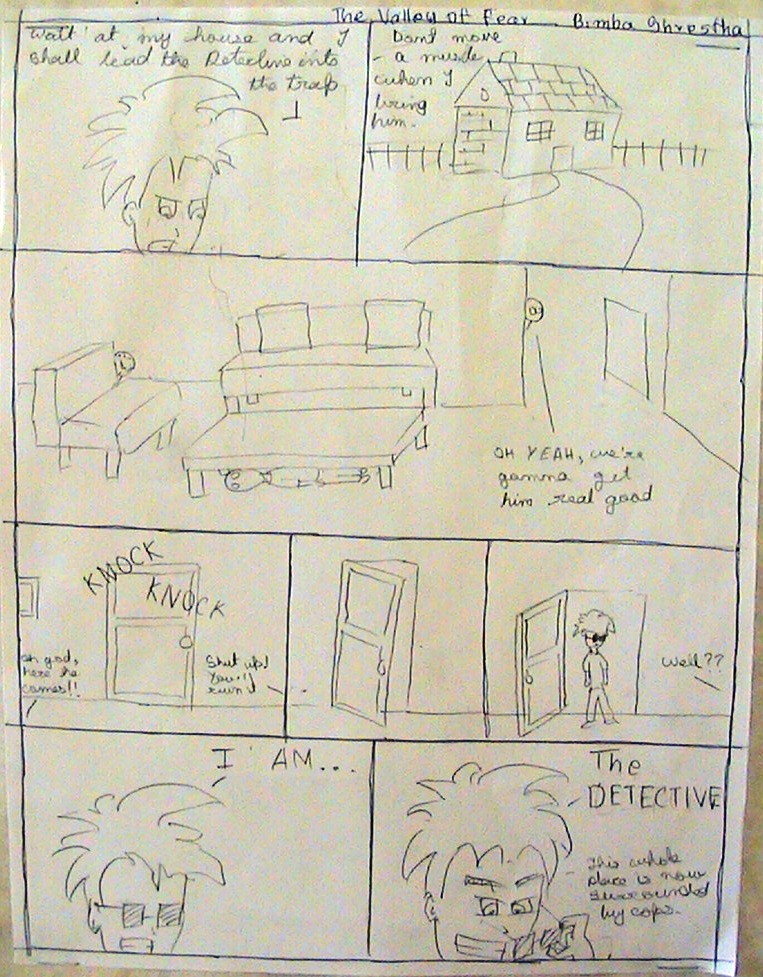
The Valley of Fear by Arthur Conan Doyle

Students have been enjoying drawing cartoons that provide a reaction to the book or illustrate a particular scene in the book. I allow students to read books other than just American literature. One of the main themes of the unit is to encourage the habit of lifelong reading.

Foundation by Isaac Asimov
The Catcher in the Rye by J.D. Salinger
The Bogey Man by George Plimpton
In addition to responding to books, students are also writing short stories and personal experience pieces. They are too long to include with this article but are certainly fun to read! We will be publishing an anthology of stories this year sometime, spearheaded by the students electing to engage in the Honors component of the class.

I hope you enjoyed our Wall of Words. I think it sets a positive learning tone for the classroom.

Copyright 2012 by Thomas L. Kepler, all rights reserved

Thursday, August 30, 2012

My 34th Year As a Teacher

And so the school year has begun . . . with appropriate background music.

As always, the preparations for a new school year took place on several levels:
  • getting the room ready, the physical structure
  • hand-outs and organizers--seating charts and course overviews
  • lesson plans and class presentations, such as what to do the first day and media materials
  • teaching strategies: differentiation, special needs, and opportunities for students to work yet not sit in their seats all period
  • bringing an attitude of open and caring enthusiasm to the classroom; bringing something new 
For me I always feel better once I'm physically with the students and interacting with them. I can think of all kinds of things to worry about or fuss over prior to the first day of school, but being in the presence of young people is my touchstone of teaching. It's where I find meaning.

Last night was Parents' Night, where the parents show up and are given an overview of the school quarter's activities. I always like Parents' Night. It's like the first day of school, the desks filled with bright, expectant faces--only in this case, parent faces!

Having good communication with parents is such a powerful teaching tool. As a grade 7-12 teacher, I am in contact with students only a short time each day. To be able to contact a parent, or for the parent to be able to contact me, is a great opportunity to increase the effectiveness of education. If everyone knows what's going on, there is less chance for misunderstanding or for those bright students to find some wiggle room in the course requirements.

Thank God for email! It makes contacting parents so much easier and so much quicker. Also, online grading is a great communication tool for schools. Parents can access their child's grades whenever they want to and can check to see when assignments are due and whether or not schoolwork has been turned in.

We have now completed the first week at Maharishi School. The introductions are over, and now we can all roll up our sleeves and get to work. I'm glad for that. I like reading, I like writing, and I like my students.

Copyright 2012 by Thomas L. Kepler, all rights reserved


Tuesday, August 14, 2012

Consciousness-Based Education and Teaching

A new school year is beginning, and I am reminded again just how important Consciousness-BasedSM education is.

Maharishi University of Management describes Consciousness-Based education in the following manner:
The purpose of Consciousness-Based education is to develop every student's total potential to the maximum — their creativity, intelligence, and happiness. This is the foundation for professional success and personal fulfillment as well as for creating positive change in society.
The university's webpage provides further detail, saying that there are four components of CBE:
  1. Direct development of consciousness
  2. A unifying framework for all human knowledge
  3. Special teaching & learning techniques that develop holistic awareness
  4. Stress-free routine and nourishing environment
The school where I teach, Maharishi School, is a Pre-K through grade 12 school that teaches Consciousness-Based education. Right now teachers are meeting and discussing points 2 and 3 on the list above.

We are reviewing and enriching our understanding of how the experience of enlivening our awareness through Transcendental Meditation can be used as an educational tool to connect the student to the teaching of the curriculum. Education knows that material presented must be meaningful and relevant in order for students to assimilate it. Pretty hard for assimilation to occur if no one's paying attention!

Consciousness or awareness is the factor that unifies all fields of study. Connecting the disciplines of study to each student's own self-awareness provides a unifying structure for learning. MUM lists four ways in which a student gains by studying at a CBE school.
  • You understand each discipline down to its depth.
  • You understand the relationships among all subjects of study.
  • You connect what you are studying to your personal growth of consciousness — knowledge becomes more relevant.
  • You increasingly experience and understand life as a whole. 
As a teacher, our pre-year inservice at Maharishi School includes studying the tools to use to implement Consciousness-Based education.
  • The whole course on the first day — In each course you take, you’ll learn all the main principles of the course at the start. The remainder of the course then elaborates these themes.
  • Unified field charts — These wall charts ensure that you never get “lost in the parts” — you always see the big picture no matter how fine the details you are studying.
  • Main point charts — These wall charts show the main points of each lesson at a glance.
  • Opportunities for working with and expressing and summarizing what you have learned — We learn best when we can do what we are learning about.
Teaching is the hardest work I've ever done, yet it is also the most rewarding. Beginning my 34th year in education, I feel that teaching in a Consciousness-Based school system gives me a fighting chance to truly make the connections that need to be made when learning: the connection between the learner and his or her own self, the connection between the learner and knowledge, the connection between knowledge and the world, and finally the connection between the learner and the world.

Who am I? 
How do I fit in? 
How can I be happy? 
What am I supposed to do with my life?

These are the basic questions of education, and in this sense, we are all life-long learners. As a teacher, having techniques, procedures, strategies, and materials to better answer the basic questions of learning provides me with the tools needed to better do my job, which is to develop the full potential of every student.
Copyright 2012 by Thomas L. Kepler, all rights reserved

Tuesday, July 24, 2012

A Book on Writing: a CreateSpace Experiment


Using twenty essays taken from posts to this blog over the last three years, I Write: Being & Writing explores the nature of writing--focusing on the writer, the process of writing, and the written word.

I intend to use it in my classroom at Maharishi School and have added activities for writing and discussion that focus on educational psychologist's Robert Sternberg's different styles of learning: analytical, creative, and practical. Some of the essays in the first part of the book, "The Writer," focus on the relationship of consciousness and writing. I explore how Transcendental Meditation has helped me as a writer.

I'm seeing how easy it will be for students to do create their own book of writing with some guidance. It has taken about three weeks so far for me to compile the book. CreateSpace at Amazon has set up a pretty easy process (of course, I've published my other books using more advanced software). I'm not done yet but am getting close!

Here is the table of contents at this time:
  • The Writer    
  • 1    I Write: Being and Writing
  • 2    Privacy and the Inner Writer: the Man from Porlock    
  • 3    Thoughtful & Spontaneous Writing    
  • 4    Writing Without Focus to Discover Ideas    
  • 5    How Autobiographical Is Our Writing?    
  • 6    Finding Your Voice as a Writer    
  • 7    Voice and Vox Populi: a Divine Tension    
  • 8    Writing That Is Progressive & Evolutionary     
  • The Process of Writing    
  • 9    The Writing Process    
  • 10    Getting Ideas for Writing    
  • 11    How Does a Fiction Writer Organize Writing?    
  • 12    Choosing the Right Words    
  • 13    Expand Your Vocabulary: an Easy, Effective Approach    
  • 14    Sentence Fluency: the Flow of Consciousness    
  • The Written Word   
  • 15    Mechanics & Grammar: How Rough Is the Road?    
  • 16    Presentation: the Final Step of Writing    
  • 17    What to Learn from a Well-written, Effective E-mail    
  • 18    Kindle as a Writing Tool    
  • 19    Specific, Useful (and Positive) Comments    
  • 20    What’s the Difference Between a Writer & a Publisher?
 I'm looking forward to teaching these 21st century skills to my students. I Write: Being & Writing should be published by mid-August. Then I'll have a clear idea of how to structure the learning process for my students.

Copyright 2012 by Thomas L. Kepler, all rights reserved

Thursday, July 12, 2012

I Write: Being and Writing

I write. This is an independent clause, the most simple of sentences--subject and predicate, subject and verb.

Dogs bark. Fish swim. I write.

These simple sentences have two parts, the break occurring between the words. Some imperative (command) sentences may be only one word long: Write. Swim. Jump! You is the understood subject.

Looking beyond the content of these sentences to the structure provides some interesting insights. The subject is the knower, the doer, the one who acts; the predicate is the process, the action, the heartbeat of the sentence. They act together to create a complete thought, consciousness becoming dynamic.

To improve as writers, we have to consider both halves of the simple sentence I write.

We have to consider the subject, the I. If I am dull or impatient or distracted or unhealthy, what I write will lack my full effort. Like an athlete, I must be fully engaged when writing. I must continue to grow and expand as a person. I started writing for myself (and not just for class assignments) when I was fifteen years old. I would hope my extra years of living I have added to the experience and wisdom that I bring to writing.

When I was twenty years old, all I wanted to do was write poetry, but a frightening, sobering experience set me back--at twenty years of age, I found myself banging against the boundaries of my creativity. I was trapped within my limitations. All I wanted to do was to write, yet I saw and felt the limitations of my writing.

I was instructed in the Transcendental Meditation technique a week before my twenty-first birthday, and I've regularly practiced TM since that time. I believe that our outer expression of life has its basis in our inner life. TM has given me rest and has quieted that inner rabble that can be so distracting to creativity. It has deepened my inner life. It's also why I teach in a school that teaches a Consciousness-Based educational curriculum. I believe students should not only grow in what they know but also in their capacity to know.

I also exercise, try to eat well and get to bed on time. I try to live a good life because I don't want to be distracted from my writing. This last spring I came down sick with the flu, which morphed into walking pneumonia. It was the sickest I'd ever been in my life. I was distracted from my writing, from my job, from everything except getting well. It reminded me that being of sound mind and body is the basis of having a successful life--as sound of mind and body as we can get, anyway. We've all got our issues, but there's no need to exacerbate them.

For all those brilliant, neurotic writers in the world, God bless them, but they (or we) are brilliant in spite of neuroses, not because of them. And I don't include our oddities, peculiarities, eccentricities, idiosyncrasies--our bizarre, outlandish, freakish habits as necessarily being beyond the norm. I hold the norm to be a very diverse and differentiated population.

Other people may engage in different activities. I bike and walk and jog. I garden and enjoy the outdoors. Others may swim, hit the squash courts, bird watch, listen to classical music, or practice the slow dance of t'ai chi ch'uan's training forms. There are many ways to improve our health, whether it be inner or outer, mental or physical. I like TM because it doesn't exclude other pursuits; it just takes us to that state of least excitation of consciousness, and from that quietness, we then move into activity, like the archer fully drawing the arrow on the bow and then releasing it. It's all part of the beginning half of the simple sentence I write.

The other half of the sentence is the verb: write. It is the process, the skill, the action. By definition a writer is one who writes, as simple as that. The trick is, OK, how well do we write? How well do we understand the process of writing?

Charles Dickens
Like all skills, learning how to write is a life-long process. It is one that demands dedication and humility and perseverance. It is one that requires a certain knack--although that may fall into the subject, the I part of I write. Studying the master works of other authors and listening to other writers' descriptions of the process of writing is all part of learning.

I write. We have to consider both aspects of that declarative sentence, of that declaration. Expand the container of knowledge. Develop writing skills. In both of these imperative sentences, the unspoken subject is you . . . or I, because I'm a writer.

I write says a lot. We must live integrated lives . . . and I haven't even attempted to discuss the sentence I am, a much more abstract, more difficult subject. Am is a state of being verb without action, only amness, isness, unity. There is a saying, that language stands at the door of the transcendent and awaits our return.

We return, as Dylan Thomas said,  to our "craft or sullen art," attempting to to find meaning in a process where our efforts, according to Archibald MacLeish, at their best, "should not mean but be."

Copyright 2012 by Thomas L. Kepler, all rights reserved

Tuesday, June 19, 2012

What Would Fairfield, Iowa, Be Without Its Bike Shop?

I'd say my son was about nine or ten when my wife and I decided to buy him a new bicycle.

Having out-grown his one-speed smaller bike, he was ready for a shifting bike. We went to A.J.'s Bike Shop in our town of Fairfield, Iowa. At that time, A.J.'s was on 4th Street in a small garage-like extension of an big house instead of his current location just off the town square.

"Just a minute," A.J. said, finishing up with another customer. After that, A.J. told us that he gave away a bicycle to every 100th customer who was buying a bike, and that we were number 100.

That was about fifteen years ago, but I still remember the moment: the small shop cluttered with shiny bikes, the smell of oils and mechanical things, and A.J. standing there in his blue mechanic's tool apron, a smile on his face while he enjoyed our happiness.

That's A.J. What would we do without such a man and such a shop in our town? I think over the years I've bought at least eight bicycles from A.J.'s Bike Shop. I've bought accessories. I've had my bikes tuned-up, modified, and fixed by A.J. I've learned about the greater world of bicycling, joined the national Adventure Cycling organization, and have even done a bit of bicycle touring. I've become a bicycle commuter, traveling to work regularly on my bike.

Now I commute regularly to my teaching job at Maharishi School, located on the Maharishi University of Management's campus. It's amazing how many places I go that are within two miles of my house--an easy bike ride. It takes as long to scrape my windshield and drive as it does to hop on my bike and get to work with pedal-power. I have a tee shirt that reads "The Bicycle: SUV of the 21st Century." Recreation includes bike rides with my wife. Bicycling has become a healthy part of my life.

I wouldn't have experienced this growth and these joys without having a local bike shop in my town. Fairfield, Iowa, was designated as one of the Great Places in Iowa, and part of its greatness is in having such great businesses as A.J.'s Bike Shop. Here is a link to a video that includes information on Fairfield's Loop Trail bike path system as part of a general introduction to Fairfield.

With great joy and memories, I celebrate my long-term business relationship with A.J., his partner-wife, and with all those wonderful bikes. There's just something happy about all those spinning wheels--and every town needs as many happy places as possible.

Copyright 2012 by Thomas L. Kepler, all rights reserved

Thursday, June 7, 2012

Eyre Tennis Center Dedicated as Long-time Maharishi School Tennis Coaches Retire


The Eyre Tennis Center was dedicated, June 6, 2012, by Maharishi School of the Age of Enlightenment and Maharishi University of Management. The indoor tennis courts are located in the university's recreation center. Speaking at the dedication were former members of the school's tennis teams, appreciative parents, state tennis officials, Fairfield mayor Ed Malloy, and administrators from MSAE and MUM.

Recognizing 25 years of tennis coaching excellence, the dedication ceremony highlighted the achievements of Laurie and Lawrence Eyre. These achievements included for the girls' coach Laurie Eyre two "final fours" in state-level tennis tournaments and one singles state champion. For boys' coach Lawrence Eyre, achievements included 15 "final fours" and 16 state championships (7 singles, 5 doubles, and 4 team championships).

Lawrence Eyre's coaching achievements included being awarded in 2009 the United States Professional Tennis Association's (USPTA) High School Coach of the Year award. This recognition is awarded to only one high school coach per year, regardless of the school's size. (More information and video here.)

Coach Lawrence Eyre's achievements were quoted in the dedication handout:
  • "In 15 trips to the final four (a state record), including 8 consecutive final fours (ties state record), from 2005-2012, the Pioneers have now earned four state team championships (1991 1999, 2000, 2002), 7 state runner-up finishes (1992, 1997, 1998, 2006, 2009, 2010, 2011), three third place finishes (2005, 2007, 2008), and now one fourth place finish [2012]."
  • "Following our 9-3 season this year--with two of our three losses to state champions Davenport Assumption (1-A) and Iowa City West (2-A)--our 25-year cumulative dual match record stands at 240-67."
  • "It has been a privilege to work with Maharishi School tennis players since 1988. Their commitment to continuous improvement has produced 16 state championships--7 singles, 5 doubles, 4 team--and 10 state runner-up finishes--1 singles, 2 doubles, and 7 team."
 Speakers at the dedication of the tennis center were from the local Fairfield community and from across the state of Iowa.
  • Early Maharishi School administrator Dennis Raimoni said that the Eyres in the classroom and on the tennis courts taught young people the important values of life--how to live life with integrity. He added that their teaching would extend those values through generations.
  • The Martlin family was prominent in the accolades. State champ Arjuna said that Lawrence Eyre exhibited and taught "amazing respect" for others and for their tennis opponents. "Respect defines who he is." Brother Luke added that that the coach "always carried himself with such dignity." Father Bob Martlin completed the family's comments by describing how Coach Eyre was to team members "not a dad but a parent."
  • Praising girls' coach Laurie Eyre, former player Avery Gibson said in a letter that the Eyres were "two of the school's most remarkable teachers" and then went on to specifically praise Laurie Eyre, stating that she "not once wavered in her support and encouragement" in all her matches, displaying "authentic commitment" to all her players.
  • Mehul Kar, 2007 graduate, who now has over 1,000 hours as a tennis instructor, stated that Mr. Eyre was "an excellent mentor on and off the court."
  • Alan Beste, Assistant Executive Director of the Iowa High School Athletic Association, came in person to the dedication to speak. He forwarded the remarks from a woman placed high in the state tennis organization who had said that Laurie Eyre was "always the professional" and that she had "unwavering confidence and support for her players." Of Lawrence Eyre, Beste said that he "always saw the big picture" in his support for Iowa tennis programs.
  • Craig Ihnen, Associate Director of the Iowa Girls High School Athletic Union, stated in a letter that "excellence in tennis is Iowa is no accident," but was due to the influence of the Eyres. He said that their professional influence created "a professional difference" in other coaches in the way the Eyres "always wanted the best for kids in tennis in Iowa."
  • Mitch Gross, Iowa City West High School tennis coach, named Lawrence Eyre "the John Wooden of Iowa athletics."
  • Craig Pearson, MUM Executive Vice President, said that the Eyre tennis program provided balance to the school. "They win tennis championships" was a balance to all the school's academic achievements. He went on to praise the Eyres as teachers: "We have that wonderful legacy they leave of enlightenment and invincibility for the world."
  • Dr. Richard Beall, chief administrator of Maharishi School, praised the Eyres for teaching that "integrity trumps winning," that the pressures of players making line calls in competition was an opportunity for the Eyres to teach the players life-long lessons in personal integrity.
  • Mayor Ed Malloy of Fairfield concluded speakers' comments by saying that the Eyres' "accomplishments have been extraordinary." He finished by saying, "What you've really accomplished has been to build character."
The comments of many of the speakers echoed the comments of Coach Lawrence Eyre, spoken in a videotaped interview played at the dedication. "A well-rounded tennis experience leads to a well-rounded life experience." Eyre also commented on his coaching experience in the dedication's handout: "I am retiring with a deep sense of fulfillment, and with gratitude for the growth that 25 years of coaching high school tennis has brought me."

Mayor Ed Malloy then went on to "pop the cork" on a new can of tennis balls, and the Eyres played the first round of tennis on the newly dedicated courts.

Laurie Eyre will continue to work at Maharishi School as a mentor to new and continuing teachers.

Lawrence Eyre will leave Maharishi School to work for the International Association of Consciousness-Based Education, traveling the world to lecture and expand the number of  schools utilizing Consciousness-Based Education, where students and faculty practice the Transcendental Meditation program.

Head of School Dr. Richard Beall ended the dedication ceremony by saying, "The idea of giving you to the world is wonderful news."

Copyright 2012 by Thomas L. Kepler, all rights reserved

Saturday, April 28, 2012

Sentence Fluency: the Flow of Consciousness

Learn to write by reading. This is good advice, but if we go back in time--way, way back--the whole process of reading and writing began with . . . a writer!

Some would say this first Writer was the Creator, the primal force of existence: "In the beginning was the Word, and the Word was with God, and the Word was God."

That Primal Force didn't have trouble saying anything--speech became creation. In the same way, the writer is also a creator, but first the writer has to have something to say. Words have to flow. This flowing, in the field of education, is labeled the higher order thinking skill called fluency: many and diverse ideas. Each idea is a flowing of consciousness; each flowing is unique.

If sentences are written with fluency, they invite being read aloud: they have an easy flow or rhythm. Sentences vary in structure and length in a way that supports the meaning of what is being written. Transitions between ideas are effective and creative. Depending on the subject and purpose of the writing, sentence fragments or non-standard grammar may be used to create a particular effect. Dialogue, if used, is natural and believable.

Samuel Taylor Coleridge stated in his Biographia Literaria (Chapter xiv), speaking within the context of poetry and of the Romantic poet William Wordsworth, that poetry ideally should flow in "a more than usual state of emotion, with more than usual order; judgement ever awake and steady self-possession, with enthusiasm and feeling profound or vehement; and while it blends and harmonizes the natural and the artificial, still subordinates art to nature; the manner to the matter . . ."

All of this cannot be achieved by following a formula. This stuff comes from within, from the wholeness of the creative vision.

Maharishi Mahesh Yogi, founder of the Transcendental Meditation program, stated the relationship between literature and writer in the following manner: "[Literature's] essential force lies in the purity of the writer, in the purity of the consciousness of the writer, who is able to bring [the] ocean in a drop, the ocean seen in a drop, that microscopic vision, that microscopic appreciation which naturally comprehends the totality on any surface value of a thing" (16, The Flow of Consciousness).

How can one improve sentence variety and creativity?

We must enrich our creativity. Expand our consciousness. For me, I do this with the Transcendental Meditation technique, practicing TM twice a day for 15-20 minutes, and then getting on with my writing. TM is a preparation for activity.
  • Now that the first Writer has written the Word, read lots of other words. Learn through example. 
  • Be self-referential. Put writing aside and then come back to it at a later date. Consider the "reader over your shoulder," your audience, as you read your writing again.
  • Be a part of a writing community. The perspective of a trusted friend (especially a writing friend) is a valuable asset.
  • Consider your purpose for writing. A simple shout of "Fire!" is appropriate if the blaze is roaring.
All of us, writers or not, are creators with every observation, thought, and action we take. The quality of our writing is dependent upon the comprehensiveness of our consciousness. Writing is cosmic. Let's make the universe we create worthy of our Creator.

Copyright 2012 by Thomas L. Kepler, all rights reserved

Thursday, April 26, 2012

Maharishi School Wins Big at DestiNation ImagNation Competition

Maharishi School has a long history of successfully competing and winning at DestiNation ImagiNation competitions. The school's entryway and assembly hall are lined with trophies and banners highlighting the school's awards.

On April 14, six of the school's eight teams "qualified for the international competition which will take place at the University of Tennessee Knoxville campus May 23-26," according to Maharishi School's "School News" blog article.
"The high school level girls’ team was honored with a special “Renaissance Award” for “outstanding skill in the areas of design, engineering, execution or performance.” The last time appraisers bestowed a Renaissance Award was in 2010 - to the same team. Two members of that team, Avery Travis and Leanna Miller were recognized for designing the Iowa state DI logo design for 2012: a shield emblazoned with the words “IOWA: Legendary Creativity” and decorated with mythical beasts."

The competitions, in which there can be no adult involvement, include both "instant challenge" competitions and long-term projects for competition. Levels of competition are elementary, middle school, and high school.

Mark Wilkins is the coordinator of Maharishi School's DI program. A full accounting of winners is listed in the "School News" article "Problem Solvers Especially Creative at State DestiNation ImagiNation Competition."

Below is a YouTube video about Maharishi School and its DestiNation ImagiNation program. It contains talks with the participants, the school's DI coordinator, parents, and shots from international competition.


Copyright 2012 by Thomas L. Kepler, all rights reserved
Information and group photo from the Maharishi School webpage

Saturday, April 21, 2012

Students Plant Trees at Maharishi School during Earth Day Weekend


"I was really disappointed last year when so many trees were cut down to prevent the spread of disease. Ever since I was born, I can remember how unique and amazing our school was with all of its trees, and I'm excited to see that the beauty will be restored," said Maharishi Boys' School senior Thomas Weiss after an afternoon filled with tree planting yesterday (second from right in photo above).

Maharishi School students, grades 1-12, as a part of Earth Day weekend activities and Alliant Energy's "Hometown Rewards Program," planted 34 trees on the school grounds.

"On Monday, April 16, Emily Swihart of 'Trees Forever,' and Scott Timm, Fairfield’s Sustainability Coordinator, gave a presentation to our enthusiastic Middle and Upper School students, as well as our 5/6 graders, and explained how trees impact energy usage," the weekly Maharishi School newsletter stated on Friday. The program is part of Alliant Energy's program to provide funds "to plant trees to help with energy efficiency, biodiversity, and carbon off-setting."


On a cool and overcast day, students in all grades, 1-12, were divided into seventeen groups, the younger students assisting while the older students provided leadership. Digging holes, planting, watering, and mulching the trees were the tasks of each group. Trees were planted at the Nature Explore Classroom, the parking meridian loop at the school's east entrance, edging the schools soccer and PE field, at the upper playground on the hill above the soccer field, and near the student parking lot.


Copyright 2012 by Thomas L. Kepler, all rights reserved

Sunday, April 15, 2012

New Adventures for Gulliver on His Travels from Maharishi School Students

Students at Maharishi School taking the British Literature course were assigned to write a "new adventure" for Gulliver's Travels. 

The three main criteria for the new adventure were as follows:
  • Story structure: beginning, middle, end (either as a story or synopsis); some conflict likely to fit the Age of Reason
  • Changing society: indication of weakness or imbalance in society; a solution is advanced
  • Proofreading: margin suggestions on D1 corrected on D2; correct submission format
Here are some examples.

New Island
--by Raphael G.

Before Gulliver finally journeys home, he lands upon one final island. This island is inhabited by two battling and contradictory races, separated by one giant river running through the island.

The first of the two races that he meets is one called the Arthantians. These Arthantians are a race that believe in deities for everything. This first astonishes Gulliver because he is used to a monotheistic society, but later he accepts the fact that they are entitled to their own opinion and that to them this seemingly outdated belief makes sense in its own context. He also starts to witness the Arthantians are very fat and slow because they are always waiting for things to happen, because they believe that there are greater beings watching over them and doing all the work for them. This leads to many of the Arthantians to become hungry and start to get weak because of a lack of them performing actions for themselves.

After spending some time with this new race, he later comes across another race when he is sent down to the central river to go fishing. This race captures him, and takes him as a captive thinking that he is a member of the Arthantians. This race that captures him is called the Platonites, and they are a race that believes solely on what can be proven through science and mathematics, and that all else is waiting to be proven or does not exist. These Platonites are the practically the opposite in appearance from the Arthantians in that they are very skinny and small and always moving. They are constantly building and creating things and are hardly getting sleep because of a ingrained need to discover new things.

This conflict in beliefs between the Arthantians and Platonites causes an ongoing battle. When Gulliver stays with the Platonites, he realizes that throughout the entire time of their existence the Arthantians have been trying to convert the Platonites, while at the same time then Platonites have been trying to destroy the Arthantians because they believe them to be less intelligent and inferior. In the end the Arthantians and the Platonites begin to fight across the central river and start to destroy each other’s villages.

Gulliver finally steps in after having spent time with both races and has a rather un-biased opinion, seeing as he personally does not subscribe to either of the two races beliefs. He gets them to stop fighting and put aside their differences after he explains that although the Arthantians and Platonites believe in different theories of existance, that this should not be a reason for violence and that they all have their own opinions and unless it causes harm, they are entitled to those beliefs.


The Island of Ness
--by Avi M.
 

Through this island, Gulliver learns an important lesson about society. Civilization can not be so obsessed with ideas or the past, that they fail to put their resources into simply moving their society along the way it is. This is shown through the idea of the “Skelts” who could be working as farmers or other productive members of society, but instead are forced by the government to hunt through the ruins of the past with little or no useful purpose. Another lesson Gulliver learns through this island is how being obsessed with ideas or the past can lead to a society centered around fear resulting from the suffering in the society as a whole. This idea is shown through the religion of this society which is based around an “evil” god who hates them.

Before Gulliver finally journeys home, he lands upon one final island. This island contains the remains of a lost utopian society and the race known as the “Ness.” When he first washes up on the shores of the destroyed island, he is brought by the ness to the king’s palace and is treated like a god upon awakening. In fact, everyone is treats him like a god. The king of the “Ness” introduces himself to him by actually bowing before him.

        Gulliver learns of the peoples past and discovers that the people believe he is someone from the “before times” who will help them unlock the secret to rebuild the perfect society. He also learns of their religion, in which they believe in an all powerful evil god, Bael,  who caused the downfall of the previous society. While he was touring their capital city, built on the remains of the largest city in the “before times,” he witnessed the hundreds of thousands starving and disease-ridden “Skelts,” who work for the government hunting through the dangerous remains of old buildings from this island's past. The Skelts supposedly work to try to discover technology and the secrets that helped make the past society so great; however, they have barely found anything.

        Gulliver suggests to the king that they put their efforts and resources more towards looking forwards for their future, instead of dwelling on the past. The king, in a fit of hysteria, declares that he must be a servant of Bael, sent to try to keep them from discovering the secrets of the great past and imprisons him in a dungeon. Gulliver breaks through the bars of the jail in the middle of the night and sneaks his way to the gates of the town. He is discovered by some of the king’s guards who chase him to the beach where he swims out to a small island. The next night he sneaks back and steals a small boat, and with no choice but to leave, sets off for home.

The Garrus
--by Bryan P.

The Garrus are a race of blue individuals who spend their entire lives to support a single individual from their population. Unbeknownst to them, the individual is not in any way superior to anyone else, but because of tradition they think not to change their ways. Because of this everyone lives in poverty and without the basics to life.

To have an enlightened society the entire population must all be on the same level of existence. Gulliver is thrust into this new environment which symbolizes the world from which he came from a far more gross perspective.

Gulliver lands on a continent called Aria. On Aria he is met by a race of humanoid blue people who call themselves the Garrus. The Garrus then take Gulliver to their leader, who is lavishly treated with riches and material things which distinctly contrast with the state of their population, who lives in slums and in poverty.

As Gulliver explores this society, he finds that the individuals live under the the impression that they live in a fully utopian society. He discovers the fact that their entire ideology is based off of pleasing a single individual who is chosen by an extremely arbitrary system of behavioral observation and thus self-depriving the rest of the population from common luxuries. After talking to The Arterian, Gulliver realizes that there is not actually anything different between him and the rest of his people, but they were too stuck in their traditional ideology to make any changes.

Gulliver decides not to get involved in the socio-political issues of the nation after failing to convince anyone that they have the power and option to raise their standard of living, but before he can get away, the system of choosing makes him the next Arterian after the previous one has died after a small aneurysm. Gulliver is forced to take the high ranking position and, after being treated to all the luxuries of the world, finds his morality which makes him teach and thus release the population from their traditions of servitude.

Copyright 2012 by the respective writers, all rights reserved

Tuesday, February 7, 2012

The Old Man and the Sea: Maharishi School Student "Book Report" Reactions

When writing about The Old Man and the Sea, there's more than one way to hook the reader's attention. Students at Maharishi School this quarter had asked for creative opportunities to respond to books read. Below are several reactions to Hemingway's novel by 10th grade students.
 
The Young Man and the Sea (a prequel)
--by Surya S.

He had been sailing for many days and nights, alone on the dark sea. Nothing had even touched his line for the past few days, and the young man was wondering if this was truly the end. He should have listened to his old man mentor when he said that the sea was too rough. The old man had told him that he had once known someone to go eighty-four days without catching a single fish, but it was probably just a lie.

No one should be going a year without fish. He was the worst form of unlucky--stupid.
The man raised his line and drew in a piece of seaweed. His first catch of he day. The man rebaited his hook and threw it into the water. The sun was setting quickly, and the man knew that if he wouldn’t catch anything now--then he would go to bed hungry for the third day.

The line was pulled slightly. Then again! The man sat slightly more forward over the stick that held the line from his boat. He tugged a little this way and that way until he was sure that he had something on the other end of his line.

Wow! I did it--my first catch of the year. This better be good, the man thought to himself. Patience, Timon, patience. Remember the story you were told about. The old man? Yes, he caught a big fish—and was at sea for many days. I must be like him! Timon slipped and accidentally tugged the line to hard. The line gave some lag, but all of a sudden it pulled back twice as hard, and Timon felt his boat slice through the waves.

What have I caught? Timon wrapped his hands around the rope--to keep the fish from taking too much lag—and started making an intricate series of knots with the other. No matter what he had caught, he would not let it go.

Santiago's Brother, Dearly Departed (an obituary)
--by Girindra S.

Martin “Marley” Marlin has died. He was seven years old.

He was harpooned to death by an old fisherman in the Gulf Stream after pulling a fishing boat for almost three days. Martin was born on July 18th, 1944, off the coast of Cuba, to parents Rodrico and Aliala.

Martin was always a bit of a warrior. He grew up with no father, and his mother was a tuna addict. Martin left the school at only one and a half years old to go and live with Ernando, his uncle, and Sabrina, his aunt.

When Martin was just a little fish, he was confronted in the schoolyard by two sharks. He left that place with a few scars; the sharks left without fins. Martin never was one to give up on anything, especially a fight, so when the hook from the old man’s line entered his mouth, he knew that he was going to be in it for the long haul.

He worked as the manager of the Mighty Mackerel, a sandwich shop on the lower east side. He loved his job, but his aspirations as a youngster were to be a gold-medalist in the Fish Olympics.

In his spare time, he volunteered at the homeless shelter, providing all of the fish there with free mackerel. He loved to know that he was making a difference and helping fish that were in need.

Martin will be succeeded by his daughter Francina, and wife Maria. All of his possessions will be given to them, as well as his house.

Martin was like a brother to many of us, and he will be truly missed.

A funeral service is being held at the town centre on August 4th.

I hope many of you can make it there to remember this great fish, father, brother, and friend.

Cod bless.


The Old Man and the Sea (an alternate ending)
--by Donovan S.

Santiago was panting; his heart racing.  With the help of Manolin, he had just managed to kill the biggest fish he’d ever encountered.  The two of them pulled the fish towards the skiff, not saying a word; they were too far in shock to speak.  They cut some lines and tied the fish to the skiff.

Manolin finally broke the silence.  “I knew it, you still have enough luck to catch this beauty,” he smiled.  “I think even the great DiMaggio would be impressed.”  That put a smile on Santiago’s lips.

“Well, we’re not back yet.  I’m worried about the sharks that will be attracted.  You can have the club, and I’ll use the harpoon.”  With that said, the two set sail back towards home.  They took shifts on who would watch for sharks while the other slept.  This much-needed rest gave them the energy they needed to take on the waves of sharks that they encountered on their way back.

Little chunks of the fish had been stolen away by sharks that came from under the boat, but because of the rest they got, they were very quick in dispatching these.  Santiago felt as if parts of himself were taken with the fish every time one of the detestable sharks managed to sneak a bite.  It was a tough decision, but Santiago was glad that he decided to allow Manolin to come with him.  The boy had pleaded, and Santiago couldn’t stand to see him in that state.  He knew now that he wouldn’t have been able to make it this far with so little loss of the fish if it weren’t for him.

“Thank you, boy,” Santiago said as they reached the docks.  Tears welling up in his eyes.  He hadn’t cried in front of the boy before.  Manolin was also crying.  When they finally reached the docks just before the crack of dawn, all the fisherman that were about to head out dropped everything they were doing and greeted them.  Everyone was cheering.  People helped the old man and the boy drag the fish out of the water.  The old man, the boy, and about five fisherman helped to walk the fish over to the butcher.  There they weighed it and gutted it.

This fish would set them up for life.  “You can retire to Africa!” Manolin said with a smile on his face and tears of joy still flowing from his eyes.  Santiago returned the smile and said, “You’re coming with me.  I’d get far too lonely with no one but lions to talk to.”
  
This is how the story of The Old Man and the Lion began.


"Online Review": a one-of-a-kind book
--by Michael C.

The Old Man and the Sea is a one of a kind book that completely deserved the Pulitzer and Nobel prizes that it was awarded. It communicates beautifully to readers what it means to be a noble human being as well as completely capturing the time and environment of the poorer coastal towns of Cuba in the 1950’s.

The book begins in the first person of our main character, Santiago, a master fisherman who has devoted his entire life to fishing. Unfortunately, Santiago has become old and unlucky in his fishing, and has gone without catching a single fish for 84 days. This story is essentially about his journey on the 85th day of his fishing when he hooks a marlin bigger than his skiff. Throughout the course of the book, Santiago shows the reader that despite him not catching anything in 84 days, despite him being looked down upon by other fishermen, Santiago pursues his passion no matter what the outcome or accusations are. He is a fisherman, and no set of events could ever change that. So call him a failure, but this really illustrates to readers that Santiago displays the sort of determination and character that every human being should aspire to have.

Hemingway goes into great detail to his process of thinking as well as his determination as a fisherman and as a man. One of the greatest aspects of this book was Hemingway’s ability to take such an insignificant situation and a seemingly insignificant man, and enlighten the reader that everything and everyone is significant, whether or not it’s obvious at first.

I would highly recommend this book to all audiences; it’s a quick, and simple read with a wonderful reminder that determination and confidence are the pathways to success.

Copyright 2012 by Thomas L. Kepler, all rights reserved
Permission granted for student writing, all rights retained by the original authors