Showing posts with label flash fiction. Show all posts

Saturday, March 5, 2022

Read My New Flash Fiction Story Published at Every Day Fiction


"He saw her reflection in the chipped mirror on the wall."
That's the first sentence of my short story "Out with the Old," published at the online website magazine Every Day Fiction on March 3. Flash fiction of a bit over six hundred words in length, it's a story of reconciliation and rebirth. 

I wrote the story in the dead of winter at a time when "the dead of winter" literally felt just like that, frozen and lifeless. Waking up before dawn with the story idea (and in the depth of winter it's not so hard to wake up before dawn), I sat down at my laptop and wrote the story in one sitting, finishing as the rose fingers of dawn caressed the eastern horizon, to paraphrase a Homeric epithet. The flash fiction story is not, of course, epic in length, nor is it an embodiment of a people as is Homer's Odyssey. However, writing the story was satisfying and even healing for me, representing my belief that we have great power over our lives, and that choosing the right action at the right time is one of the great benefits and opportunities that human consciousness provides.

"Old with the Old" was written in one sitting, revised a couple of times in the next week or so, and then revised on a few technical points, based on the Every Day Fiction editor's comments, then resubmitted. Every Day Fiction publishes one new flash fiction story every day of the year, paying its authors a whopping three dollars. Twelve years ago, I published another story for EDF, a Halloween story titled "Spider," which one reader's comment was "A great, creepy tale for Halloween!"


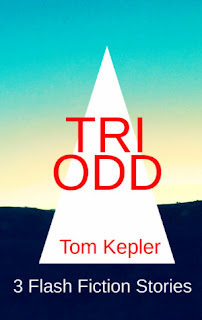
Three flash fiction stories are compiled in my Amazon ebook Tri Odd, which besides "Spider" also includes "Cull," a mildly macabre story about a retired English teacher (go figure!), and a science fiction genesis story, "In the Beginning." All three stories have been published in online magazines over the years.


In addition to flash fiction, I also have published at Amazon another three short stories from my The Stone Dragon universe--Who Listened to Dragons. These short stories emerged from a map from The Stone Dragon novel. I looked at the map and asked myself, "I wonder what's happening there?" And thus the stories were born. I have several other unpublished stories written that are set in The Stone Dragon universe, and when enough are written, I'll publish a short story compilation, Tales of the Stone Dragon Inn

Getting back to "Out with the Old," it's a story I submitted under the "Spring" category at EDF. It does have that sense of a breath of fresh air about it, one that I created for myself by writing the story--and if you're ready for a bit of spring yourself, follow the link to the story and enjoy!

Follow by Email

* indicates required

Tuesday, January 11, 2022

A Flash Fiction Experience

This has been an interesting winter, what with a front tooth extraction (tooth #9). The experience literally put me off my feed, and it also motivated me to give myself a break and to take it easy for a while. Funny things can happen, though, when stepping back for a little rest--good-funny things. Writing a flash fiction story recently was one for me.

I woke up at dawn, which is not unusual for me, but I had this scenario in my head, this story, this moment when reality shifts. And so I got up, sat down with my laptop, and wrote out the mind event--680 some words. The storyline is about an elderly couple checking out a new "antique shop," aka junk store, for some new finds. The theme, though, is about reawakening and rejuvenation. Set in spring, my subconscious must have already been looking past this winter while I slept. I'll take the gift. 

I revised the story about four times over a month, working with my comfortable routine of writing and then letting the work sit for a time before coming back to it. One thing I like about flash fiction is the quick return on my effort. The satisfaction of saying, "Yes, it's done!" doesn't have to be put off for a year or two. That's a good feeling.

I've submitted the flash fiction story to the online literary website Every Day Fiction. Theme submissions seem to be my flash fiction forte (alliteration!) for this website. My previous publishing here was a Halloween story called "Spider." My submitted story, "Out with the Old," is submitted for the March theme of springtime. 

Until March arrives (and if the story is accepted), feel free to read "Spider." I had wanted for years to write a creepy story, so writing a Halloween story was a fun exercise. Another flash fiction story, published on New Year's Day in 2011 at 365 Tomorrows is "In the Beginning," a science fiction story. I do seem to flash on specialty themes. This sci fi story is a twist on the Adam and Eve narrative.

Now for me it's on to writing more on my science fiction story that I've been posting on Amazon's Vella, titled at this point Grav Board. I started this novel during an emotionally challenging time, just sitting down at the keyboard and letting myself slip off into another universe, exploring another planet. Great fun! I've taken about six weeks off from this story, so now it's time to get back! Cheers!

Follow by Email

* indicates required


Friday, April 5, 2019

Tri Odd: An Exploration of the Quirky, a Free Ebook

What do you do when you've finished your novel, published it, and are ready to embark on the next project? I decided to stretch my writing envelope, to try some characterizations, genres, and topics that I had not attempted before. One consequence of that experiment in writing is the free ebook Tri Odd, three flash fiction stories where I set some writing ground rules that were--for me, anyway--non-typical.

I wanted to write about characters I didn't like or admire. I wanted to try writing something besides fantasy, to "cleanse my palate" after my hundred-thousand-word novel The Stone Dragon. I wasn't tired of fantasy; I just wanted to try something new. The end result was a science fiction story, a thriller/horror story, and a crime story. Macabre? Quirky? Maybe, but experiments under a thousand words. I wasn't ready to channel Stephen King for a couple hundred thousand words.

"Cull" is a story about a retired English teacher, a wiry, elderly woman who is very much in control . . . and as hard as nails. She loves rabbits, breeds them for show, and has organized her life just as she wants it to be. Then an interruption occurs and the story begins. "Cull" was originally published in Metazen, an online daily fiction site which is now defunct.

"In the Beginning" is a science fiction story that was fun to write. I enjoy reading science fiction but had not ever written in the genre. The story provides a science fictional perspective to the Biblical story Genesis and how humanity has always had this thing about following directions. It was published by the online flash fiction website 365tomorrows, on New Year's Day.

"Spider" is a thriller/horror story. I'm not sure it can be classified as "horror" because I don't wallow in the creep factor, but there is a slow and subtle sidling up to the macabre situation that arises when one fixates on spiders in the month of October. The story was originally published by the website Every Day Fiction, on Halloween Day.

One powerful characteristic of flash fiction is the power of inference. In one thousand words or fewer, the reader must be provided clues so that the ramifications of the storyline can be inferred. The words stop but the story continues in the imagination of the reader. I enjoyed using that writing technique in these stories, of providing a kicker. In a very real way, flash fiction is much like poetry in that every word is composed in a manner to provide a "more than usual meaning."

Tri Odd is available as an ebook for free at the following links. Feel free to read the stories, and hopefully you will be inspired to read more of my writing.

Tri Odd at Amazon

Tri Odd at Smashwords


Sunday, January 27, 2019

Building a Free Ebook--Tri-Odd


I haven't published anything for a while beyond my blog--and I'm interested in getting back into my independent publishing part of my writing. Therefore, I'm putting together a free ebook of three flash fictions stories that were published in three online magazines a little less than ten years ago.

  • "Cull," in Metazen, 2010 (magazine no longer active)
  • "Spider," in Every Day Fiction, 2010
  • "In the Beginning," 365 tomorrows
I mention these three and more in a blog post, "A Cat Has Nine Lives--How Many a Writer?" that summarizes my publishing over the last years. I've tried quite a few different genres and formats!

I am glad that in this small way I'm refreshing my publishing sites, reviewing the steps of publishing, and reviving my writing beyond blogging. I'm also enjoying reminding myself how to do some basic work with photos in order to create blog headers and book covers. All good--and useful--skills.

It's a cold, cold Iowa winter, my wife's gone on business, and I'm looking forward to exploring a new publishing venture. Without cost to me or my readers, no worries! I'll let you know when the ebook is available.

Thursday, February 23, 2017

Another Indies Unlimited Flash Fiction Contest I've Lost

copyright K.S. Brooks
Yep, lost another one . . . and I'm happy.

This contest provided a photo visual prompt, a grey ocean beach, which reminded me of a short story that I've worked on over the last few years, drafting different beginnings, different storylines, different points of view, but never feeling the story was moving in the right direction.

I think writing this 250-word story got me to the right place, allowed me to discover the right angle. So I celebrate my happy loss.

The short story has had several titles:
  • Lonely Is a Bitter Wind
  • Waves Like Dragon Wings
  • People of the Beach
  • Elemental
  • Ocean's Daughter
This flash fiction version of the story was written while traveling on Amtrak, so it was a real pleasure to sit in my roomette, watching the miles roll by, drafting offline on Google Docs. Receptivity comes and goes while on the train, so I worked offline after reading the Indies Unlimited writing prompt. And writing on my iPhone 6+ was easy--a little slower than on a laptop, but maybe that's not so bad. I also really like not having to pack around a lot of electronics!

I'm looking forward to expanding the story from this 250-word shorthand version.

The first line of "Ocean's Daughter" reads: Stone and driftwood and the bitter sea–all is grey, water-worn, salt-bleached and half-buried.

The story is posted in the comments section of the UI blog post, if you'd like to read it--250 words, a quick read! I've linked the title above to the blog page.


Saturday, June 14, 2014

I Successfully Lose a Writing Contest

The writers' blog Indies Unlimited hosts a weekly writing contest from a prompt they provide--250 words max. I wrote about my entry into the contest on my last blog post.

I lost.

However, I'm writing today about how I feel good about the results. Yes to Success and all that.

First, I wrote a short story that is set in my Dragons of Blood and Stone universe. Every time I enter that universe, I feel good. So far so good. Also, the fact that the story might fit into my collection of short stories, Tales from the Stone Dragon Inn, is an extra plus.

Second, I feel my little experiment with social media marketing was successful. Because I was busy early this week, I didn't see the voting post at Indies Unlimited until 4:30 AM on the deadline day. By the time I posted my mini-marketing blog post, it was 5:00 AM--allowing 10 hours for marketing my entry for support.

Facebook marketing came later that morning--status updates on my personal Facebook account and on my Tom Kepler Writing page. I also sent a Facebook note to a dozen Facebook friends.

The results? Twenty percent of the votes, the winner receiving 23%, with most of the winner's votes already on tab at 4 AM that morning. Now, the 10 possible hours for voting for me were from 5 AM to 3 PM on a Thursday, my time here in Iowa. I deem my hurry-up mini-marketing adventure a success.

Thanks for all who supported me. Since the Indies Unlimited writing contests are fairly informal (the winners are published in an anthology), I didn't want to push the marketing envelope too much--just enough to see if anybody out there is paying any attention.

People did pay attention. That makes me glad. Thank you, all.

Copyright 2014 by Thomas L. Kepler, all rights reserved

Thursday, June 12, 2014

I Enter a Fun Flash Fiction Contest (How's That for Alliteration?)

I've entered a writing contest, winners determined by reader votes.

Every week the independent publishing blog for writers, Indies Unlimited, has an informal flash fiction contest for its readers. You can vote on the winner, voting deadline today, 5 o'clock PM Pacific time.

A writing prompt of text and photo is provided, and the submission must be no more than 250 words. I submit a story every now and then when a prompt gives me an idea that will fit into a story that could be used in a collection of stories I'm writing set within the Dragons of Blood and Stone fantasy series. When I finally gather enough short stories, I'll publish a collection titled Tales of the Stone Dragon Inn.

Winners are determined by vote, so I'm giving my readers here a chance to read some short, short stories, to observe some writers having fun, and to provide you a chance to vote on your favorite story. Sorry this is such short notice, but I've been busy taking education classes for a couple of days.

This week's topic was "The Great Dessert Riot."

Here's the link to the voting blog post. That link also provides a link to the contest short stories, which are in the comments section.

Have fun. My entry isn't titled, but I'll call it "Piety" if I use it for my short story selection. Enjoy.

Copyright 2014 by Thomas L. Kepler, all rights reserved

Thursday, July 4, 2013

"T 'Uk's Dilemma": a free fantasy short story about Post-traumatic Stress Disorder

The 4th of July is a celebration of a declaration of freedom, of fighting for a cause and defending what we believe in.

One of 3 short stories that I am offering for free this July is called "T 'Uk's Dilemma." At a little over 1,000 words, the flash fiction is a look at two of the characters in the novel The Stone Dragon, the Tucker brothers.

They are a tragi-comic pair of brothers who, out in the middle of nowhere, own two inns, each on the opposite side of a stream, and who compete for business with one another. "T 'Uk's Dilemma" explains how their eccentric behavior came to be and precedes The Stone Dragon chronologically.

T 'Uk finds himself torn between a warrior's obligation and the Way of the Sisters of Hospitality, a tradition in which his mother had raised him. Also, in The Stone Dragon, some characters practice the Silence of the Saints, a form of meditation.

Having practiced Transcendental Meditation most of my life and seeing how effective TM is in dealing with Post-traumatic Stress Disorder, the short story is a study of just how life-changing the stress of violence can be to the mind. I tried in the story to find a metaphor to convey the fracking a mind can experience by overwhelming events.

This short story and two others are available for free now at Smashwords: Who Listened to Dragons, Three Stories.

Thursday, May 10, 2012

"Wally, the Door Greeter": a story inspired by the opening of a super Wal-Mart in my town

Shopping carts were rattling down the aisles of the Super Wal-Mart's grand opening, serious folk in blue aprons bustling about to assist the shoppers.

The Manager noticed an empty space at the front of the store, though, where all the carts were supposed to be, all slid one inside the other in rows of neat readiness like dollar bills in a wallet.

"Wally," the Manager said, "you need to hit the parking lot and grab some carts. We're running low."

"I would prefer not to," Wally said in a perfectly deadpan manner.

The Manager was somewhat put off by the negative response. After all, the store would provide "70 new jobs, savings for local shoppers and an increase in tax revenue to support the area’s economy," according to the corporate website," but the Manager was busy, assumed Wally had good reason, and sent another blue-boy off for the carts.

Later on opening day, the Manager suggested to Wally that he separate some of the carts so that customers could easily grab them and roll off to consumer bliss.

"I would prefer not to," was Wally's response.

"But it's your job to be jolly and offer a cart," the Manager replied.

"I would prefer not to."

The afternoon progressed with conditional negatives, Wally doing nothing but staring out the window, customers muttering, "You can't fire him! Remember the baby movie Where the Heart Is!"

This was Wal-Mart, after all, and there were standards. The day ended with Wally sitting on one of those benches set in concrete in front of the sliding entrance doors. Wally might as well have been set in concrete.

The Manager tucked some stale french fries into the crook of Wally's arm, then turned to his car to leave for the night. A chance thought, and he returned to Wally and whispered in his ear, "Tomorrow we'll put you in charge of the Lost and Found department."

Wally made no response. The Manager was heartened, though, and decided the absence of the negative could be considered a positive. He would prefer to think so, anyway.

This story was suggested by "Bartleby the Scrivener," by Herman Melville.

Copyright 2012 by Thomas L. Kepler, all rights reserved

Tuesday, January 31, 2012

Three Short Stories to Publish as an Ebook


I've decided to publish three short stories as an e-book to sell for $.99, which comes to about 125 words per penny.

The cover above is in its current incarnation.  I took the original photo and used a section to save as background color with texture--just plain color wasn't dynamic enough. Then I added that twice as a background layer, top and bottom of the image. I added the eye section of the original photo to the middle. Then I used the feather gradient to blend everything. I added the text, originally a red, but I felt the white showed up more and also provided more unity because of the white of the eye. Finally, I rotated the eye to give more dynamism to the image. With the text, I played around with bevel/emboss, stroke, and character height to add more presence to the text. Then I removed the bevel/emboss because the letters didn't stand out so much in a small thumbnail size image (what most online cover images will be). There are probably more things I could do, but I had a lot of fun. I'm really getting the hang of layers in PhotoShop. It allows for a lot of experimentation without messing up what works.

The one below was my first try. I just didn't feel good about it. Not as much dynamism--in my opinion, anyway.


  • "Who Listened to Dragons," 9,500 words.
  • "River's Daughter," 2,500 words
  • "T 'Uk's Dilemma," 1,200 words
The other two cover's aren't really necessary, but I added them inside the book to front the stories. I can also add them for "extra images" to go on Amazon and Barnes & Noble.

All three short stories are set in the Dragons of Blood and Stone series reality, the setting of The Stone Dragon.  I also found an image that I think will be great for the SD sequel, Dragons of Blood and Stone. I hope to start working on that by spring at the latest.

Right now I have the e-book uploaded to my Kindle, and I'm going through it for a last time, looking for little errors and formatting issues. I wrote about this process in my blog post "Kindle as a Writing Tool."

Adding photos makes the process a little more tricky, especially when uploading to different sites (Kindle and Smashwords). Sometimes you just have to say, "This is as good as it's going to get with the current technology."

I plan to publish the books on my birthday, this Thursday, February 2. If I can feel comfortable with the e-formats, then publishing the stories will be my birthday present to myself. At this point, I think I probably won't make that birthday goal. I don't want to lower the quality of the product for an artificial deadline.

I've also been enjoying making covers for the stories. The three stories will be published under Who Listened to Dragons, but I made covers for each story to front the short story in the e-book.


I like the Dragons of Blood and Stone image. It connects with the cover image on The Stone Dragon. This was a quick version of the cover. I think I can make it better with more time, but having the cover is a real inspiration to start Draft 2 of the novel!

I'm also playing around and making banners for advertising. Here's one I've made for the e-book. It's smaller because of the size required for the half-banner advertisement. I'll change it to use the new "blue" image, but I was practicing using a sideways (horizontal) format.


These will be the first publications that I've used online stock photos for. That is a fun experience, looking through huge catalogs of images to find one to use. The price is really inexpensive, too.

Copyright 2012 by Thomas L. Kepler, all rights reserved

Monday, December 13, 2010

Figment: Write Yourself In (a new writing site for young writers)

They're out there--the sites where writers can upload their writing and get feedback from others.

Figment is a new site, organized and catering to young adult writers, although there are no restrictions on age (after all, I'm a member). However, one of Figment's moderators, Lindsay, is twenty-two, according to her forum post.
"What is figment? Figment is a community where you can share your writing, connect with other readers, and discover new stories and authors. Whatever you're into, from sonnets to mysteries, from sci-fi stories to cell phone novels, you can find it all here."
In a recent article titled "Web Site for Teenagers with Literary Leanings," the Wall Street Journal discovered that the creators of the site had originally envisioned a sort of "literary Facebook for teenagers." They discovered, though, that teenage writers wanted something different.
“I really went into it and thought, ‘We’ll be the social network for young-adult fiction,’ ” said Mr. Lewis, a former managing editor of The New Yorker. “But it became clear early on that people didn’t want a new Facebook.”

The young people on the site weren’t much interested in “friending” one another. What they did want, he said, “was to read and write and discover new content, but around the content itself.” 
 To me, an apt comparison is that Facebook is standing on a street corner and chatting. Figment is sitting in a coffeehouse or bookstore, friends gathered round, sharing the literary ambiance.

Even in its days-old infancy, the site has the challenges one would expect. An avatar which contains a four-letter word beginning with "F" that ain't fish or fork. Folks on the forum complaining about the concept of "appropriate material" and asking all kinds of questions about exceptions. In other words, normal stuff.

The tabs bar icons for the site read as follows: home, figment library, figment features, contests, forums, blog. The personal signed-in tabs read my desk, my writing, i'm following. Yes, this really is a site for text-messaging writers; the "i'm" is not capitalized.

I'm following and interacting with the site for a while. If it looks dynamic and nurturing, I'll recommend it to my students. In the meantime, I've uploaded four pieces: some flash fiction, a poem from my book Bare Ruined Choirs, and the first four chapters of Love Ya Like a Sister.

Enjoy!

Copyright 2010 by Thomas L. Kepler, all rights reserved

Tuesday, November 9, 2010

365tomorrows: Online Flash Fiction Zine Review


So I was browsing flash fiction online zines, seeking something of interest: then came the thought, "I've submitted to 365tomorrows, read the stories, read the About section, like the zine . . . and the only reason I'm not reviewing is because I have a story submitted with them?

Hmmmmmmm . . .

Okay, I won't send an email telling the zine about my review until after the editors respond to my story. That seems a reasonable balance between sucking up and allowing myself to write about a zine I like.

From the About page: "365 tomorrows is a collaborative project designed to present readers with a new piece of short science and speculative ‘flash’ fiction each day. Launched August 1st 2005 with the lofty goal of providing a new story every day for a year. We’ve been on the wire ever since."

I really like the visual 1950's vibe this zine provides with black and white images and satellite dishes. Rampant raygunners and mad motorcycle gogglers. Fedoras and femme fatales. (See Writers section.)

According to URL Dogg, "365tomorrows.com gets about 4,585 pageviews per day."

Kathy Kachelries is listed as "Founder and Staff Writer" on the byline of the 365tomorrows' article "What Is Flash Fiction?" The article is framed by Stephen R. Smith, "Site Admin and Staff Writer."

Daily sci fi fare is a combination of submitted stories and stories written by staff writers. It is a labor of love and a business. (URL Dogg states that the site "earns an estimated $13.76 daily" and is the 238,639th most visited site on the internet.")

The site is capricious, utilitarian (think "cold steel in outer space"), and literary: a wonderful combination.

If you submit flash fiction to 365tomorrows, be sure the word count is 600 or fewer. 
"Legal breakdown: When your story is accepted, you're giving us first electronic publication rights and non-exclusive subsequent publication rights. This means that we get to be the first to publish your story, and then, after it's been put up on the website, we can stick it in a printed book or on a flyer or something of the sort, as long as we give you credit. We don't, however, own your story. After it goes up, you are free to sell it for millions of dollars or cut a movie deal without needing our approval, as long as the people who buy it know that they're buying it non-exclusively."
The site includes a forum, podcast capabilities, and a news link.

And, of course, the stories. Care to try one?
  • How about "Good Humor," by Eric Kimball
  • An audio podcast from Voices of Tomorrow called "Grandpa"
A last word from the online zine: "Flash fiction is, in my opinion, the next frontier in writing. With the world moving along at a breakneck pace, fewer and fewer people have time to read longer works, which some would argue is leading to a decrease in overall reading. Not true. People read more now than they ever have before: the internet is made for reading. That's why I started 365tomorrows: to make fiction for the internet generation."


There! A good pitch for an excellent online science fiction zine. And, of course, if they receive a Google Alert and read this review, I just hope the editors don't, in fairness, over-compensate and reject my story to demonstrate that I haven't swayed them with my Vulcan mind meld.

Subscribe to Tom Kepler's Writing Blog by Email


Copyright 2010 by Thomas L. Kepler, all rights reserved

Tuesday, November 2, 2010

The Antagonist: giving the dark side a face

In the classic movie Jeremiah Johnson, starring Robert Redford, the comment is made that the greatness of your enemies is a measure of your greatness. 

I'm not sure I want to be a part of that universe, but the comment does point out the crucial relationship in a story between the protagonist and the antagonist.


Here are the important literary terms related to this subject from about.com:
  • Protagonist: the main character or hero in a work of literature.
  • Antagonist: the opponent of the main character in a work of literature.
  • Foil: a character who serves as a contrast to another perhaps more primary character, so as to point out specific traits of the primary character.
I am in the process of choosing unusual and even unsavory characters for some of my flash fiction stories, honing my skills by developing characters I would avoid in real life.

As mentioned in an earlier post, here are some characters I've included in recent flash fiction stories:

  • a ninety-year-old retired English teacher who decides to "cull" a neighbor (published)
  • a grandmother who tells the story of how she once found a head in her bread dough 
  • a man arrested for public nudity on St. Patrick's Day
  • a sci-fi Adam and Eve story (submitted)
  • a family that makes a Saturday high school detention a picnic opportunity
  • how insanity and spiders do not mix (published)
  • how an Alamo car-rental agent plays Cupid (submitted)
  • a gambler who bets his jackpot against a job as a farmhand--and hopes he loses
  I think my wife, though, has the best and final comment of antagonists: sometimes the most interesting characters are those who traits are not so easily categorized.

Sometimes the guy on the horse doesn't wear a white hat or a black hat but a hat of grey--or is it just the way the shadows play beneath the cloud-dappled sky?

Copyright 2010 by Thomas L. Kepler, all rights reserved

Thursday, October 28, 2010

Hint Fiction: a "flash" version of flash fiction, AND a contest!


Never mind 1,000 words or fewer--how about 50 words, 30 words, 25 words or fewer for a short story?

Author and anthologist Robert Swartwood has coined hint fiction as an ultra-short fiction--25 words or fewer, as a matter of fact.

In his article at Flash Fiction Chronicles (linked above) he states:
Me, I want to coin a term, so I’m going to do it here and now: those very, very, very, VERY short stories should be called Hint Fiction. Because that’s all the reader is ever given.  Just a hint.  Not a scene, or a setting, or even a character sketch.  They are given a hint, nothing more, and are asked — nay, forced — to fill in the blanks.  And believe me, there are a lot of blanks.
  He is the editor for the anthology Hint Fiction: An Anthology of Stories in 25 Words or Fewer, published by W.W. Norton and Co. From the publishers webpage blurb:

A story collection that proves less is more.
The stories in this collection run the gamut from playful to tragic, conservative to experimental, but they all have one thing in common: they are no more than 25 words long. Robert Swartwood was inspired by Ernest Hemingway's possibly apocryphal six-word story—"For Sale: baby shoes, never worn"—to foster the writing of these incredibly short-short stories. He termed them "hint fiction" because the few chosen words suggest a larger, more complex chain of events. Spare and evocative, these stories prove that a brilliantly honed narrative can be as startling and powerful as a story of traditional length. The 125 gemlike stories in this collection come from such best-selling and award-winning authors as Joyce Carol Oates, Ha Jin, Peter Straub, and James Frey, as well as emerging writers.
Swartwood will be the judge for a hint fiction contest, too, sponsored by Smokelong Quarterly. Celebrating their 30th issue, the SQ will choose the perfect hint fiction of exactly 30 words--so submit during the thirty days of November.

Thursday, October 21, 2010

Writing Outside "the Box": Flash Fiction as a Process

For me, the novel is a "box."

A very nice box, thank you--but a 100,000 word structure that has needs and issues that must be addressed . . . and addressed again. A novel is an investment, a dream, a journey, a lifestyle. A novel is the horizon I've been chasing, if I may allude to Stephen Crane's poem.

Flash fiction is one percent of a novel in length (in round figures), yet the final project can eyeball a novel with equal dignity--a complete, self-sufficient work of art. Consider Ernest Hemingway's famous six-word short story: "For sale. Baby shoes. Never worn." It's all there: characters, conflict, setting, climax, resolution.

Flash fiction allows me to climb out of the jumbo, novel-sized box I live in, my paper tortoise shell, and to stop and smell the flowers. In fact, I'm doing that just by thinking about flash fiction--the previous sentence includes three metaphors (four if you want to consider flash fiction a nascent metaphor).

Here are some characters I've included in recent flash fiction stories:
  • a ninety-year-old retired English teacher who decides to "cull" a neighbor (published)
  • a grandmother who tells the story of how she once found a head in her bread dough 
  • a man arrested for public nudity on St. Patrick's Day
  • a sci-fi Adam and Eve story
  • a family that makes a Saturday high school detention a picnic opportunity
  • how insanity and spiders do not mix
  • how an Alamo car-rental agent plays Cupid
  • a gambler who bets his jackpot against a job as a farmhand--and hopes he loses
Even assuming that I could finish a novel every six months (presumptuous!), four years of commitment are seeded in those stories--probably more like 8-12. And they'd be good novels, I think--but I don't want to write them. I've got a number of dandy cardboard boxes already waiting in the attic.

The process of writing those flash fictions has enriched my writing life. I'm proud of my babies. I find more opportunities now for tighter writing. I see more opportunities to include and develop interesting and colorful characters in my writing. I have more compassion or insight into the antagonists of my stories.

I'm a better writer, I'm a flash fiction writer. You can bet the farm on it.

Hemingway's Royal
Copyright 2010 by Thomas L. Kepler, all rights reserved

Tuesday, October 12, 2010

Late in Life: a flash fiction story

Today I'm leaping off the precipice--a leap of trust.

Sometimes I wake up in the early hours of the night with an idea, and sometimes I get up and write that idea. That is the genesis of a file in my documents named "Drafts Night Stories." These are stories that wake me up and command me to write them--no matter what the time. They are different stories, some strange and some bathetic (although perhaps I should plead guilty to the lesser charge of sentimental).

This last Sunday, 10/10/10, was the birthday of my first wife, who passed away in 2003. This story below was my first "Night Story," and I opened the file this last weekend for the first time since writing the story. I'm posting it today, after some revision.

It's odd how a story can take so much from a writer's life yet still not be autobiographical. I am not the person speaking in the story; "Gloria" is not my first wife. What can I say? The experience of two people is in the story, but not the actual people? Details yet not the wholeness?  Here is the story, anyway, less scholarly and more personal than usual. A fiction--truth garnished with a light sprinkle of fact.

Late in Life

We married late in life, Gloria and me, everyone surprised because we were so set in our ways. The thing is, those ways matched so much we didn’t have to change, not important things, anyway. We just kept on, comfortable together.

No children, not to say we didn’t try, I’ll tell you that right now. But mostly we spent our days doing, side by side. Never mind the Gaudy Gras, just earth tones and a joy in the eyes.

And then Gloria was sick and then thinner and then didn’t want to walk so far. Fool that I was, I didn’t see a thing till she asked to see a doctor. She didn’t fuss about it, but she knew, and knew I didn’t know. So we went on about our business, except I got the tea and dusted the house, our walks shorter, Gloria leaning on my arm. She never wanted a walker or a cane; my arm was better. Finally she had one beside her—a cane, that is—used it when I was gone to work.

The neighbors helped during the week—five ladies, Gloria’s Monday-through-Friday Angels, she called them. Alone, all of them, widows or never-married, but comfortable. Some on pension and some with a bit and helped a bit by family (moved off to a good job in Colorado) and one her own money, thank you very much. They'd come over and sit in my chair and later beside the bed. Washed her, cleaned the house. Oh, I did my part and more, as some told me, but they’d come over, sometimes two together “just for a chat.” I knew what they were up to, but that had nothing to do with us. Gloria, we always supported each other: sick in bed, the other helped, hand and foot. I remember the flu one year, how she bathed my face and brought me broth when I could keep it down.

Then Gloria asked me to take her to the hospital; she could tell, even with the pills. I called next door, and we lifted her to the wheel chair and got her to the car. After she couldn’t move, the doctor had told us how to keep an extra sheet on the bed. We could lift her up like a hammock or a sausage rolled in a piece of bread—lift to the chair, wheel her to the car, lift her again, and off to the hospital. Why not call the ambulance, you might ask, but two-mile ride cost hundreds, so we did it ourselves, even with insurance. I cleaned her myself at the end, always me. She wanted it that way. Massaged her cold, pale feet, calluses peeling off because she couldn’t walk, couldn’t move. I never told the ladies, and they never brought it up. We had our ways of making it easier, they thinking of me, me thinking of Gloria—nothing wrong with that.

My routine was work what I could and then walk to the hospital. It was spring and the walk across town eased the tension—that’s how I felt about it. The oaks were budding and the grass was green, daffodils and hyacinths in bloom. Gloria never could stand daffodils in the house, too much onion smell, but she loved them outside, so bright and cheerful. I’d sit by the bed, and she’d make sure I poured myself some tea from the Thermos. Then we’d sit and talk, or just sit. I was sitting, anyway. She’d ask me what was blooming and budding, what smells were in the air. She told me to change my shoes before walking, checked if I’d watered her philodendron and fed the cat. I kept my routine—had to—people don’t figure it, but dying doesn't kill a routine, just changes it. She kept a close eye on me. That’s how she lived, some through me. Otherwise, it was just hospital stainless steel and what the nurses did. I was her feet, tired as they were. I talked about whatever, did anything, just a garden tool that fit her hand, there in reach. I left behind who I was in a good way: woke up and thought, what needs to be done? Never considered what I wanted to do, didn’t want anything, just stuck to the routine and did what needed doing.

She passed one evening in May when I was walking. Robins were flying, twigs and grass in their beaks, starlings enjoying their arguments. Tulips cupped bold colors in their hands, a lawnmower growled. Sam Jenkins’ garden was a beautiful sight, raised beds straight and clean, four by twenty feet, the spinach and chard up, peas on the trellis. The Franks’ dog was loose but knew how to get home. We knew it could happen anytime, but never thought it would. Not me, anyways, not really. She’d gotten by and through it for so long—damn if I didn’t think she’d get through this one too. It’s strange she didn’t, and just plain odd I didn’t see it.

I still hear her voice, change my shoes. Small steps, maybe, but I’m on my feet, I’m walking.
Copyright 2010 by Thomas L. Kepler, all rights reserved


Wednesday, October 6, 2010

Online Fiction Review: a Review of an Online Flash Fiction Magazine

I'm thinking of something like the paper-printed magazine the North American Review, which was founded in 1815 and is "the nation's longest-lived literary magazine and among its most distinguished."

Thomas Jefferson was one of  NAR's early subscribers; I am one of Flash Fiction Online's early subscribers.

(And now, I suppose, it's time to get down to business.)

Flash Fiction Online casts a dignified shadow on the virtual literary world, publishing 2-3 new stories a month in addition to commentary and/or "classic flash," short fiction by our venerable predecessors, now out of copyright. 

Quality is an item Flash Fiction Online must focus on, since it has cast aside the concept of quantity. Longevity is also a fragile term for the internet; Flash Fiction Online has been around since 2008, not quite as long as the North American Review.

Published monthly, the "front page" features six sections: the "In This Issue" in the upper right hand corner, and the hooks of the other five features. The arrangement works well, once I realized the logic. On the left is a sidebar for navigation to previous issues, and "about" section, and other traditional pages.

From the "About Us" page:
At a high level, our goals are pretty simple.
  • To serve flash fiction readers and writers with a professional, sustainable market for flash fiction stories.
  • To promote the general population's reading of great short stories in general and of great flash fiction in particular.
That implies a variety of sub-goals:
  • Provide fiction readers with accessible, interesting flash stories that have a plot, characterization, and, to the extent possible, setting.
  • Meet the SFWA requirements for being a pro market: 1000+ consistent subscribers, $.05 / word, non-vanity press, and consistent publishing for a year.
  • Provide fiction writers, and especially flash writers, with links and information about writing.
  • Promote the short story form to a general audience.
  • Provide new writers with an additional shot at professional publication.
Magazine staff are from the United States: a retired commercial nuclear power industry guy, a father (8 kids from the same wife), former elementary school teacher, and software engineer. Slush readers are journalistic, tree-hugging, car-pooling, dermagraphic artistic (think tattoo), Utahan Wyomingistic fantasists--the usual mix.

I found the flash fiction story in the August 2010 issue, "Is, Not Mighta Been," by Dave Hoing, a very powerful story.
"Some folks see the hand of the Lord in happenings that nothing but dumb chance. They say He separate people or bring them together by His own plan. Well, I say God don’t bother Hisself with our daily affairs, so if you see a man in a place you don’t expect, then that just one of them things. Ain’t no beam of light breaking through the clouds or angels singing hallelujah. Just is, is all."
An "Author Page" lists some of the zine's writers; it has a formal look with photos of just the authors' eyes--cool concept. The magazine also hosts a flash forum that is fairly active, judging from the number of topics and posts. There is a useful arrangement of posts: for readers, for writers, for art, and a place to introduce yourself or add something "general."

If you like to sip and savor your fiction, try Flash Fiction Online. As a writer, if you can write "a complete story in one thousand or fewer words," then submit. Remember, though: Stories have characters. Stories have plots. Stories have settings. (And this magazine is looking.)

Along with all our venerable predecessors.


Subscribe to Tom Kepler's Writing Blog by Email

Copyright 2010 by Thomas L. Kepler, all rights reserved
Wednesday, September 22, 2010

Metazen: Online Flash Fiction Zine Review

"On behalf of Metazen, and my own disdain for double negatives, I've chosen your piece 'Cull' for publication on the site. I'll write you soon with the exact date that it will go up, but in the mean time, I send my congrats!"

Metazen is the perfect second flash fiction magazine review, since it has just accepted one of my flash fiction stories for publication. The reference to "double negatives" is one relating to my short story: the main character, a retired English teacher, disapproves of a former student's behavior--and the fact that he never moved past speaking in double negatives.

The first review of this series was of the online zine Every Day Fiction. I characterized that publication as having "an orderly, conservative appearance," adding "and that's fine by me. I prefer the 'flash' to be in the fiction."

Metazen is more whimsical, quirky, eccentric. I like the feel of the publication and the unexpected humor, both visual, literary, and editorially self-inflicted. The magazine isn't afraid to poke fun of submission/publication rituals, and the editors aren't leery of poking fun of themselves. I'm still "poking" around the publication itself, finding little nooks of information--decoding little nuggets such as "metazen began in March 2009 on a small coffee table with Frank staring at a bluish screen. Frank was drunk and hopeful" and "metazen does not believe in non-fiction, both in a literary sense and an existential sense."

I'm still thinking about that last example.

Metazen publishes both short fiction and poetry, following a daily schedule. "On Saturday- a ‘literary saturday morning cartoon’ is published," and "on Sunday- a “best of metazen” is (usually) published."

A visual is provided to increase one's understanding (see rocketlady).

 Submissions: You need to read this page because it's a joy.
  • Here's a flavor: "We will accept stories no longer than 3000 words. If your story is longer, please query first. Send a snippet. If it is batshit good then of course we will bend." 
  • And here's another: "Here come the tired the best way to know what we want is to read what’s on our site line. Though this is very, very true, if you are one of those A-holes that doesn’t like to read the site before submitting then maybe the list below will help you out a bit."
  • I feel like I should comment on the publication's stance regarding metafiction, but feel self-conscious about doing so.
These lines begin the Submissions page, though--words that show a respect for literature and writers: "Metazen accepts pieces of fiction, poetry and art. We look forward to reading your submissions and we treat every piece we recieve with a respect for its potency. We publish daily and therefore are (as of this update) never closed to submissions."

 Go to Metazen, enjoy yourself. Read some stories before you submit. That way you won't feel guilty for being one of those shameless "A-holes."

Subscribe (or "follow") this blog for future online magazine reviews.

Subscribe to Tom Kepler's Writing Blog by Email

Copyright 2010 by Thomas L. Kepler, all rights reserved

Monday, September 13, 2010

Every Day Fiction: Online Flash Fiction Zine Review


I have the honor of having been rejected by Every Day Fiction
"Relationship stories," both make-ups and break-ups, are tough sells to EDF, particularly when they seem to be the point of the story. We see a lot of them and for one to stand out, it has to be really good or bring something new to the table. (Regarding the story "Snow Gone to Rain.")
One learns to take rejections in stride--to reflect, to learn, and to move on. One editor did mention the following: "There is lots of talent here and I would like to see more work by this author."

Nonetheless, the letter ended with the ubiquitous "We wish you good luck in placing the story elsewhere." 

There is a point to my comments on the story's rejection (other than whining): it was accompanied with personal comments from two editors. I've learned to enjoy and appreciate any feedback that extends beyond a form rejection letter. Thank you, Every Day Fiction magazine.

Every Day Fiction publishes each day a story of no more than 1,000 words. "There’s no such thing as too short. if you can tell a story in 50 words, have at it!"
All fiction genres are acceptable, and stories that don’t fit neatly into any genre are welcome too. While personal experiences and other non-fiction can be great sources of inspiration, please turn them into fiction for us, or send them elsewhere.
Our readership is adult, so children’s stories are unlikely to be accepted unless they are relevant to adults as well. On the other hand, we are not impressed by gratuitous sex and violence, or pointlessly foul language; edgy content should be necessary and appropriate to the plot and characters.
It ought to go without saying that any story submitted to Every Day Fiction must be your own unpublished original creation. If you publish a story on a blog, even your own personal blog, it is considered published and therefore inappropriate for our market.
 Every Day Fiction pays three dollars per story--a mostly symbolic yet appreciated gesture of respect. One may donate the remuneration back to EDF. The zine also provides links to your blog, webpage, or your Amazon book page.

I have published two poems through EDF's sister zine, Every Day Poets. The staffs of both publications have been friendly, respectful, and industrious (a poem/story a day!). The magazines have published "best of" anthologies and EDF also maintains a blog, Flash Fiction Chronicles. The zine's staff is international, although the publication appears to be based in Canada.

The webpage embodies an orderly, conservative appearance, and that's fine by me. I prefer the "flash" to be in the fiction.

Subscribe to Tom Kepler's Writing Blog by Email

Copyright 2010 by Thomas L. Kepler, all rights reserved

Friday, May 7, 2010

A Student Writes Flash Fiction

A 10th grade student has just submitted a flash fiction story for extra credit.

Preparation for the writing included reading flash fiction stories from the Every Day Fiction site, stories written by me, and also some examples from Edgar Wiseman's book of flash fiction called Briefs. Prior to this flash fiction unit, as a class we had also studied short stories that fit into the "schools" of realism, naturalism, and regionalism--writers such as Mark Twain, Bret Harte, and Kate Chopin.

The student has agreed to work on the story with me and then submit the story to Every Day Fiction.

The story has an excellent title, "Leap of Faith," which has both literal and thematic significance.

The beginning works well:
The cliff was huge, dark, and intimidating. Every rock was sharp. The cliff collided with the water, and the dark waves crashed against the stone with loud beats.

The conflicts include both inner and outer challenges. Dialogue, two different settings, and characterization are significant to the story.

I'm a strong believer of creating literature as a powerful procedure for learning to analyze literature. "Doing" teaches in ways that "talking about" never gets to. In terms of higher order thinking skills, "synthesis" is a different thinking skill than "analysis."

And, who knows, maybe somebody will get published.

Copyright 2010 by Thomas L. Kepler, all rights reserved